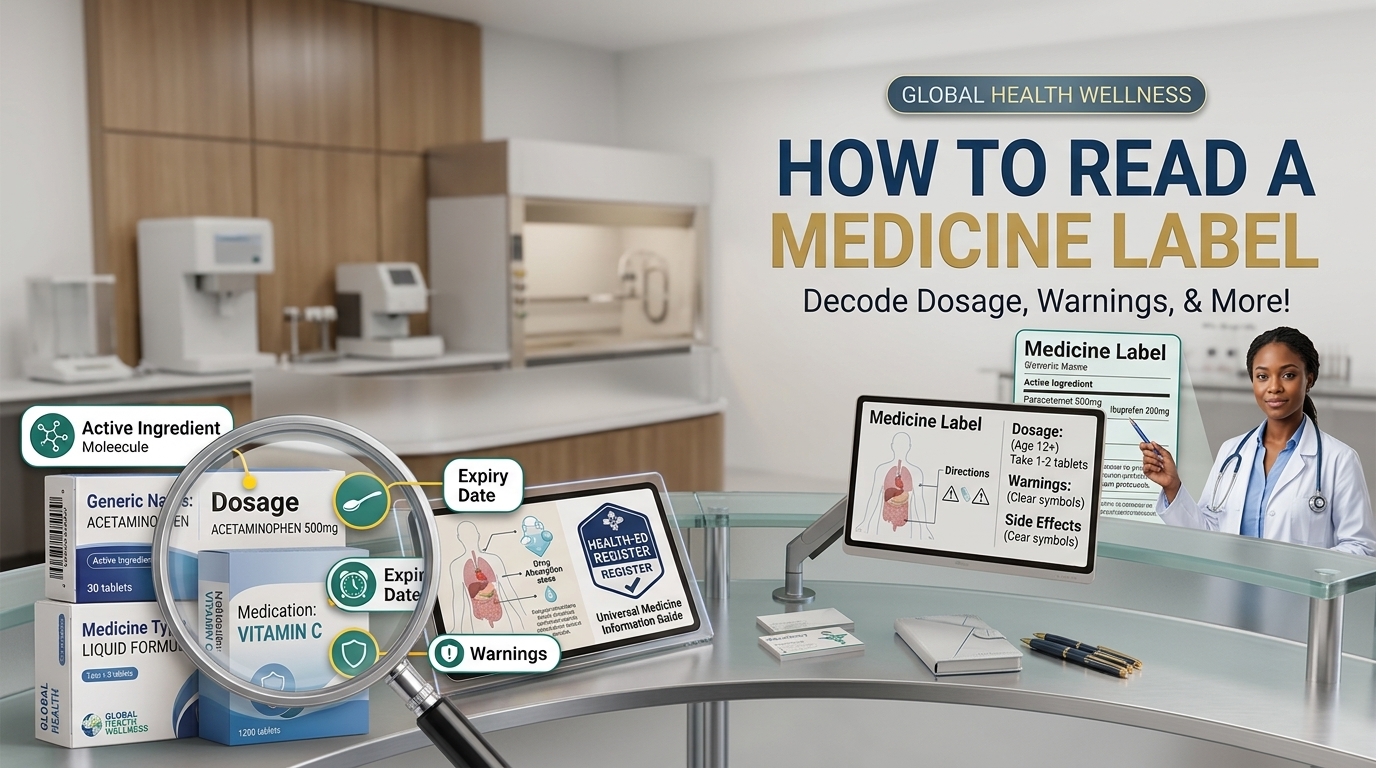
Knowing how to read a medicine label in Nigeria takes about two minutes. It can save you from a wrong dose, an expired pack, or a fake drug.
Most of us check the brand name and the price, then pay. But the label says much more, and NAFDAC's rules spell out what must be printed on it. Treat those rules as your checklist before the first tablet goes into your mouth.
Why the label deserves two minutes
The World Health Organization says at least 1 in 10 medicines in low- and middle-income countries are substandard or falsified, which means they are of poor quality or fake. Those products can contain too little of the active ingredient, the wrong one, or none at all. You can't fix that problem alone. You can, however, catch many bad packs at the counter.
NAFDAC's Drug and Related Product Labelling Regulations 2019 say drug labels must be prominent, legible, and in English. They also ban false or misleading statements. A pack that fails those basics deserves a second look.
How to Read a Medicine Label in Nigeria, Part by Part
1. Brand name and generic name
The brand name is the company's trade name. The generic name is the common name of the medicine itself. Under NAFDAC rules, a branded drug must show both, and the generic name must be printed as large and clear as the brand name. You should also see the dosage form and strength in a format like "Tablets 200mg."
2. Active ingredient
The active ingredient is the part that does the work. The label lists it with the amount in each unit, for example, "Each film-coated tablet contains" followed by the quantity.
Read this line every time, even for a medicine you know. Different products can share the same active ingredient. Paracetamol appears in many cold and flu remedies, and the US FDA warns against taking more than one product that contains it (the US calls it acetaminophen). A paracetamol tablet plus a cold and flu sachet can quietly stack two doses of the same drug.
3. Uses, dose, and warnings
Over-the-counter labels must state what the drug treats, the dose (including amounts for specific age groups), how often to take it, warnings, who should not use it, and side effects. They must also advise you to see a doctor if symptoms persist. If all that won't fit on the pack, a leaflet must come inside.
Measure liquid medicine with a proper dosing tool, never a kitchen spoon. NAFDAC rules require a graduated measuring device (one with dose marks) in packs of oral liquid medicine for children.
Prescription drugs work differently.
A prescription pack won't tell you what the drug treats, because NAFDAC rules bar prescription packages from stating the indications. Instead, the pack must come with a leaflet covering uses, warnings, side effects, and dosage. If it's missing, ask your pharmacist.
A note on scored tablets
Some tablets have a line across the middle. NAFDAC rules call for a statement on whether that line is meant for splitting or just for easier swallowing. Don't split a tablet unless the label or your pharmacist says you can.
4. Manufacturer name and address
The label must name the manufacturer, give its full location address, and name the certificate of registration holder. If a contract firm made the drug, wording like "Manufactured for X by Y" should explain the link. A missing or vague address is a warning sign.
5. NAFDAC registration number
Look for "NAFDAC Reg. No." on the carton and, in most cases, on the inner label too. The print should be clear, not scratched off, covered, or altered. Still, a printed number proves little on its own, because counterfeiters can copy genuine numbers. Confirm it, as the next section shows.
6. Batch number and expiry date
The batch number and expiry date must appear together. The batch number ties your pack to its full manufacturing history, so it can be traced if something goes wrong. The expiry date must be on the inner container and the outer carton, unless it's easy to read through the carton.
By NAFDAC's definition, the expiry date is the date up to which the medicine is expected to stay within specification if stored correctly. So follow the storage instructions on the pack. Blister strips must also show the brand name, generic name, strength, batch number, and expiry date on every strip. A strip missing those details should stay on the shelf.
7. Child warning and storage
Every drug label must carry a warning to keep the medicine out of children's reach. Check the storage line too, and keep the pack where it says.
Check the Label Against the Official Record.
A label only shows what the pack claims. Test the claim. Search the product on NAFDAC's Greenbook, the agency's registered product database at greenbook.nafdac.gov.ng. Confirm that the name and active ingredient match your pack. If the number belongs to a different product, don't use it. You can also start on VerifyProducts.ng, then confirm on the Greenbook.
Antimalarials and antibiotics get one more check. NAFDAC rolled out its Mobile Authentication Service for them in January 2012. Scratch the panel to reveal a one-time PIN, send it free to the provider's short code, and you'll get a text saying the product is genuine or suspected fake. A code that's already been used is a red flag.
What to Do If Something Looks Wrong
Warning signs include missing English text, hard-to-read print, a missing batch number or expiry date, and a registration number that looks scratched off or covered. Don't use the product. Keep the pack and your receipt, and report it to NAFDAC. You can call the complaints line on 0800 1 623322 or use the online reporting portal for substandard and falsified medicines at nafdac.medsafety.io. You can also report on our website, so we can escalate it.
Next time you buy medicine, read the label, check the number, then pay. Those two minutes are cheap protection for you and your family. Share this with anyone who buys medicine for your home.