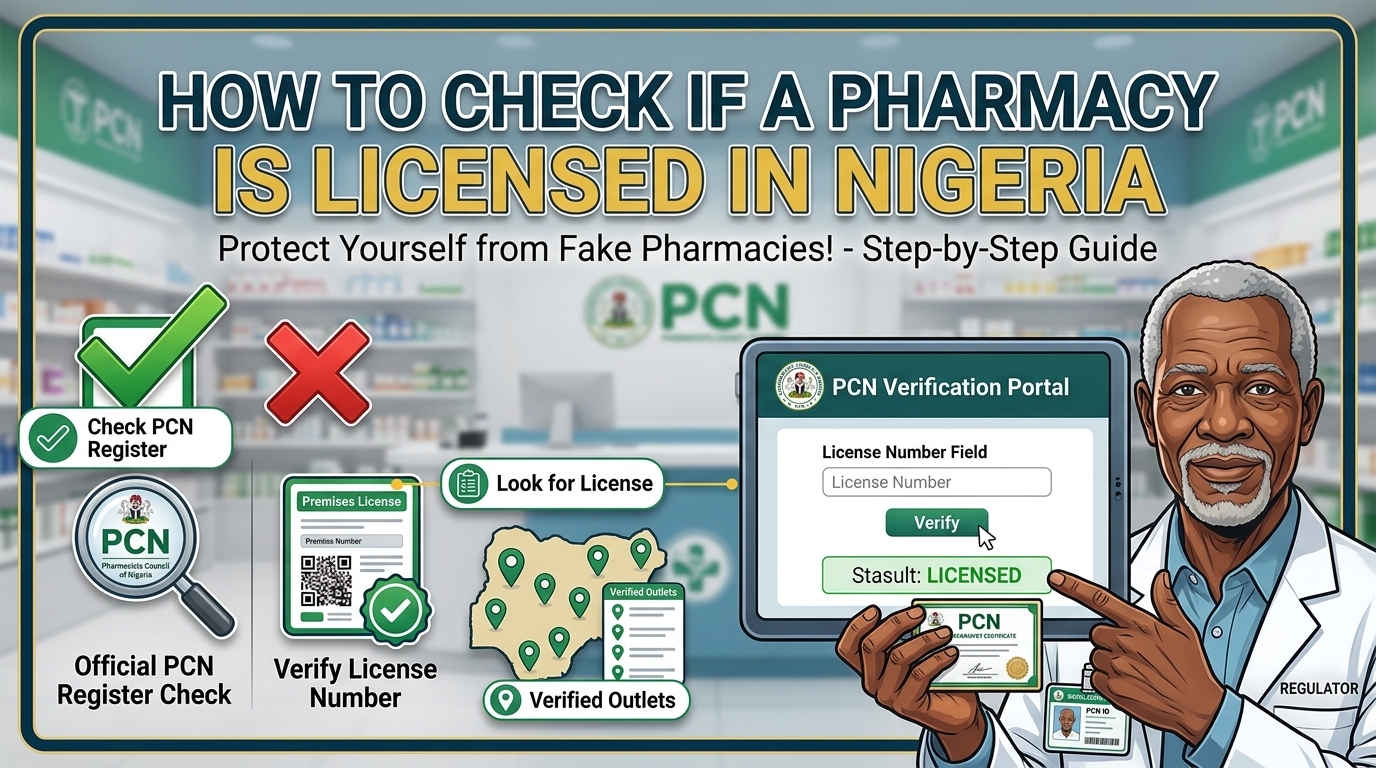
Knowing how to check if a pharmacy is licensed in Nigeria matters before you hand over money for medicine. A shop can have a neat signboard, a white coat behind the counter and full shelves, and still have no valid registration. The good news is that the regulator lets you look it up yourself. This guide shows you how, in a few minutes, and what to do if the answer worries you.
Why the shop matters as much as the box
The World Health Organization estimates that at least 1 in 10 medicines in low and middle income countries is substandard or falsified, and says these products are often sold online or in informal markets. UN risk reduction guidance notes they can reach pharmacies and clinics too. So a licence doesn't remove every risk. It does put a regulator between you and the seller, and that's worth checking.
Who licenses pharmacies in Nigeria
The Pharmacy Council of Nigeria (PCN) regulates pharmacy practice in Nigeria. It was called the Pharmacists Council of Nigeria until 2022, when the Pharmacy Council of Nigeria Act 2022 set up the current agency. PCN registers pharmaceutical premises, licenses pharmacists each year and licenses patent and proprietary medicine vendors, known as PPMVs.
NAFDAC does a different job. It registers products, which is why you check the NAFDAC number on the pack. PCN licenses the shops and people who sell them. A safe purchase needs both checks.
PCN licenses several kinds of outlet: hospital pharmacies, community pharmacies, wholesale and importation businesses, manufacturers and warehouses, and patent medicine vendors. If you buy in bulk for a clinic, church or shop, ask the supplier for its PCN registration.
How to Check if a Pharmacy Is Licensed in Nigeria in Four Steps
Step 1: Note the exact name and address
Before you buy, write down the name on the signboard and the shop's address. The PCN search works from the premises name, so an exact spelling helps.
Step 2: Search PCN's premises tool
Open pcn.gov.ng and choose "Verify Premises." The page is called the Premises Certificate Verification System, and it asks you to type the first few letters of the premises name. Then compare the result with the shop in front of you. The name should match, and so should the address, if the result shows one.
If nothing comes up, don't jump to conclusions. A registered name can differ from the signboard, so ask the pharmacy for its registered name and search again.
Step 3: Verify the pharmacist
PCN also offers a "Verify Pharmacist" search on its homepage. Ask who the pharmacist in charge is, then look that person up. NAFDAC's labelling rules define a prescription drug as one dispensed by a registered and licensed pharmacist, so this check matters most when you're buying prescription medicines.
Step 4: Ask to see the paperwork
PCN issues certificates of registration for premises and annual licences for pharmacists. Ask to see both. A genuine pharmacy shouldn't mind, and one that refuses has told you something.
What the search can't tell you
The PCN tools speak to the premises and the pharmacist, not to the products on its shelves. It can't tell you whether a given pack is genuine. For that, you need the label and NAFDAC checks covered below.
Pharmacy or patent medicine shop?
PPMVs are legal, and they serve many communities, but their licence is narrower. PCN's licensing page says patent medicine vendors are licensed to sell over the counter medications and health products. Studies describe them as barred from selling prescription drugs such as antibiotics. So if a patent medicine shop offers you antibiotics with no prescription, walk away, licence or not.
Signage is still a pilot
PCN is piloting branded signage for patent medicine shops, and its published list covers Lagos and Kaduna. A shop without that branding elsewhere isn't automatically unlicensed, so don't judge by the signboard alone.
A quick word on online sellers
Treat online pharmacies the same way. Ask for the registered premises name and the pharmacist's name, then search both on PCN's tools. A seller who dodges the question isn't worth the risk.
Red flags at the counter
Watch for a few warning signs. The staff can't name the pharmacist in charge. Prescription medicines are handed over with no prescription. Packs have no NAFDAC number or look expired. NAFDAC has repeatedly advised Nigerians to avoid unregulated drug sources, and street hawkers and open market stalls are the obvious examples. Our guide to spotting a fake drug market covers those signs in detail.
A licensed pharmacy is a start, not a guarantee
Even a licensed pharmacy can stock a bad pack, so keep checking the product. Read the label before you pay, confirm the NAFDAC number, and search the product on VerifyProducts.ng if you want a quick second look. Then confirm on NAFDAC's Greenbook.
Before you pay: a two minute routine
Here's the short version. Search the premises on PCN's tool. Look up the pharmacist. Read the label and check the NAFDAC number. Then pay. Do it every time you try a new pharmacy, and save the search link on your phone so it takes seconds.
What to do if a pharmacy isn't licensed
Don't buy from it. If you want to report the outlet, contact PCN at connect@pcn.gov.ng or visit the nearest PCN zonal office. PCN lists its zonal offices on its website, and its contact page lets you submit an inquiry online. If you've already bought a product that worries you, keep the pack and report it to NAFDAC on 0800 1 623322 or through nafdac.medsafety.io.
You can also use the Report Fake page on VerifyProducts.ng and check current product alerts.
A pharmacy licence check takes a few minutes. Do it once for your regular pharmacy, and you'll know where your family's medicines really come from.